

Quick answer: For many whole-house generator installations in Greater Houston, a 500-gallon propane tank is a practical starting point, but there is no single tank size that works for every home. A 250-gallon tank may work for shorter backup goals or a dedicated generator supply, while a 1,000-gallon tank can provide substantially more reserve for extended outages or homes with higher propane demand. Generac currently specifies a minimum 250-gallon LP tank, but that manufacturer minimum does not determine the best tank size for every property.
The right propane tank size depends on generator fuel consumption, electrical demand during an outage, desired backup duration, other propane appliances, fuel-line requirements, vaporization capacity, available space, Texas clearance requirements, and delivery preferences.
What Size Propane Tank Do You Need for a Whole-House Generator?
A 250-, 500-, or 1,000-gallon aboveground propane tank can potentially supply a whole-house standby generator. The right choice depends primarily on how much propane your system can use and how long you want your stored fuel to last.
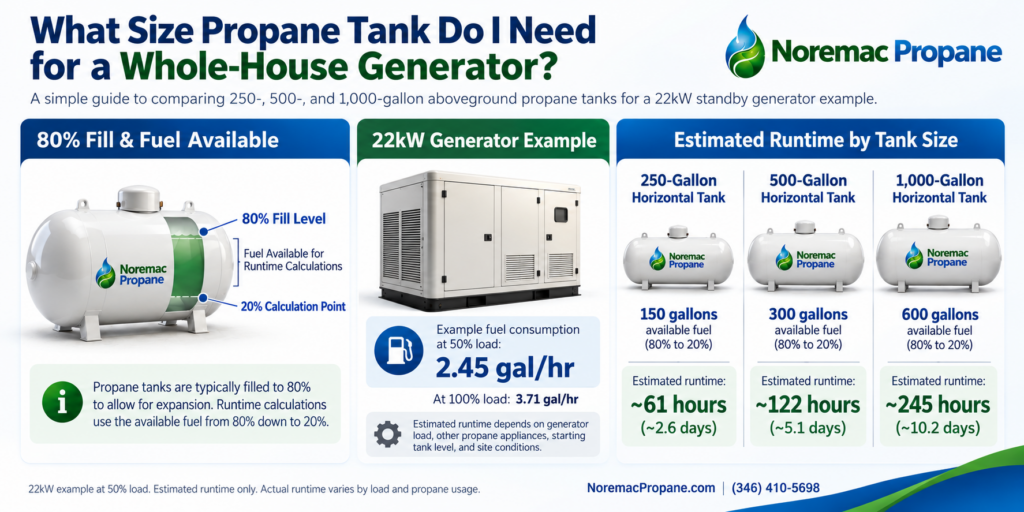
Propane tanks are normally filled to about 80% of their rated capacity to allow room for liquid propane to expand as temperature changes. For planning purposes, this guide compares the fuel available from an 80% tank level down to a 20% calculation point.
| Tank size | Approx. propane at 80% | Fuel from 80% to 20% | When it may make sense |
| 250 gallons | 200 gal | 150 gal | Smaller reserve, generator-only use, or shorter backup goals |
| 500 gallons | 400 gal | 300 gal | A practical option for many whole-house generator installations |
| 1,000 gallons | 800 gal | 600 gal | Longer backup goals, higher total propane demand, or fewer desired deliveries |
These are planning examples, not fixed sizing rules. A homeowner preparing for a short outage may make a different decision from someone planning for several days of hurricane-related power loss. A tank supplying only the generator also has a different fuel profile from one supplying water heating, cooking, fireplaces, pool heaters, or other propane appliances.
How Much Propane Does a Whole-House Generator Use Per Hour?
Residential standby generators in the examples below use roughly 1.7 to 4.0 gallons of propane per hour depending on the model and electrical load. The same generator can consume substantially less propane at 50% load than at full output.
Current Generac specifications list the following LP consumption rates: View Generac specifications
| Generac generator | 50% load | 100% load |
| 14kW | 1.76 gal/hr | 2.92 gal/hr |
| 18kW | 1.65 gal/hr | 2.87 gal/hr |
| 22kW | 2.45 gal/hr | 3.71 gal/hr |
| 26kW | 2.05 gal/hr | 3.95 gal/hr |
| 28kW | 2.23 gal/hr | 3.97 gal/hr |
Fuel consumption does not rise perfectly with kW rating because different generator models and engine designs have different performance characteristics. A home’s electrical load also changes throughout an outage as air conditioners, refrigerators, pumps, lights, and other equipment cycle on and off.
That is why manufacturer 50% and 100% load figures are best used as comparison scenarios rather than guaranteed household consumption rates.
How Long Will a 500-Gallon Propane Tank Run a 22kW Generator?
Using current Generac 22kW specifications, a 500-gallon propane tank provides an estimated 5.1 days at a constant 50% load or about 3.4 days at a constant 100% load when calculated from an 80% tank level down to 20%.
A 500-gallon tank contains about 400 gallons at 80% and about 100 gallons at 20%, leaving approximately 300 gallons for this comparison. Generac lists the 22kW model at about 2.45 gallons per hour at 50% load and 3.71 gallons per hour at full load.
Generator Runtime Formula
Available propane ÷ propane consumption per hour = estimated runtime
At 50% load: 300 ÷ 2.45 = about 122 hours, or 5.1 days.
At 100% load: 300 ÷ 3.71 = about 81 hours, or 3.4 days.
These are calculated examples assuming a constant load and generator-only propane consumption. Actual runtime can be shorter or longer depending on electrical demand, other propane appliances, weather, starting tank level, and the specific generator.
How Long Do 250-, 500-, and 1,000-Gallon Tanks Last With a 22kW Generator?
Using the same Generac 22kW example, the difference in stored fuel becomes easy to see:
| Tank size | Fuel available (80% to 20%) | Est. runtime at 50% load | Est. runtime at 100% load |
| 250 gallons | 150 gal | ~61 hours / 2.6 days | ~40 hours / 1.7 days |
| 500 gallons | 300 gal | ~122 hours / 5.1 days | ~81 hours / 3.4 days |
| 1,000 gallons | 600 gal | ~245 hours / 10.2 days | ~162 hours / 6.7 days |
A larger tank provides more reserve, but bigger is not automatically better. Tank placement, clearances, available space, total propane demand, delivery preferences, and cost still matter.
What Is the Minimum Propane Tank Size for a Generac Standby Generator?
Generac currently specifies a minimum 250-gallon LP tank for its home standby generators. That is a manufacturer minimum, not a recommendation that every Generac installation should use a 250-gallon tank. Generac guidance
A 250-gallon tank may be appropriate when the desired backup period is shorter, the generator has a lower fuel demand, or the tank is dedicated to the generator. A 500-gallon tank provides roughly twice the stored propane and can significantly extend runtime. A 1,000-gallon tank may be useful when a homeowner wants a larger emergency reserve, has several propane appliances, or wants fewer deliveries.
Two homeowners can own the same 22kW generator and reasonably choose different tank sizes. One may want two or three days of emergency power, while another may be planning for a prolonged Gulf Coast outage. Generator consumption, household propane use, property layout, vaporization capacity, piping, and clearances all need to be considered.
Noremac Propane is not affiliated with or endorsed by Generac. Manufacturer specifications are referenced for educational purposes.
Can a Whole-House Generator Share a Propane Tank With Your Home?
Yes. A properly sized propane system can often supply both a standby generator and household propane appliances from the same tank.
A shared tank can simplify monitoring and delivery, but every appliance connected to it draws from the same fuel reserve. Water heaters, furnaces, cooking appliances, dryers, fireplaces, pool and spa heaters, and outdoor kitchens can all reduce the amount of propane available to the generator during an outage.
A dedicated generator tank separates the emergency fuel reserve from household use. Neither setup is universally better. The right choice depends on the existing propane system, available installation space, total BTU demand, desired outage reserve, and installation cost.
Why Is a 500-Gallon Propane Tank Only Filled to About 400 Gallons?
A 500-gallon propane tank is normally filled to about 80%, or roughly 400 gallons, because propane needs room to expand as temperature changes. The remaining space inside the tank is intentional.
The same principle applies to other tank sizes: a 250-gallon tank holds about 200 gallons at 80%, while a 1,000-gallon tank holds about 800 gallons. The Railroad Commission of Texas incorporates NFPA propane standards into the state’s LP-Gas Safety Rules.
If a 500-gallon tank does not accept 500 gallons during a normal fill, that does not mean it is being underfilled. The rated tank size and normal liquid propane fill level are different measurements. Texas LP-Gas regulations
When Should You Order Propane While Running a Generator?
If you monitor your own tank, Noremac’s Houston delivery guidance recommends requesting a delivery around the 30% level rather than waiting until the tank is close to empty. During widespread outages or severe weather, ordering early gives dispatch additional time for routing and delivery. Noremac delivery guidance
The runtime examples in this guide use 20% only as a consistent calculation point. They are not a recommendation to wait until 20% before ordering propane.
Running completely out can also require additional safety procedures. Texas training material based on NFPA 54 states that after gas service is restored following an interruption of service, the piping system must be checked for leakage before appliances are placed back into operation.
What Affects How Long a Propane Generator Will Run?
Tank size is only one part of the runtime equation. Actual propane use can change based on:
- Electrical load: A generator working harder consumes more fuel.
- Air-conditioning demand: In Greater Houston, central A/C can be one of the largest electrical loads during a summer outage.
- Other propane appliances: Water heaters, fireplaces, cooking equipment, pool heaters, and other appliances draw from the same tank.
- Generator model: Similar kW ratings can have different manufacturer fuel-consumption specifications.
- Starting tank level: A tank starting at 70% provides less reserve than one starting near a normal full level.
- Desired fuel reserve: Some homeowners plan for a few days, while others want significantly more emergency capacity.
This is why “How many days will my tank last?” cannot be answered accurately from tank size alone.
How Far Does a Propane Tank Need to Be From a Generator or House in Texas?
There is no single tank-to-generator distance that applies to every Texas installation. The generator can be an ignition source, and placement requirements can involve the tank size, fill connection, relief-valve discharge, building openings, mechanical air intakes, property lines, and the generator manufacturer’s own installation requirements.
Texas currently incorporates the 2017 edition of NFPA 58 and the 2018 edition of NFPA 54 into its LP-Gas Safety Rules. The tank and generator locations should therefore be evaluated together instead of relying on one blanket distance found online. RRC regulations
Tank-to-House Planning Distances
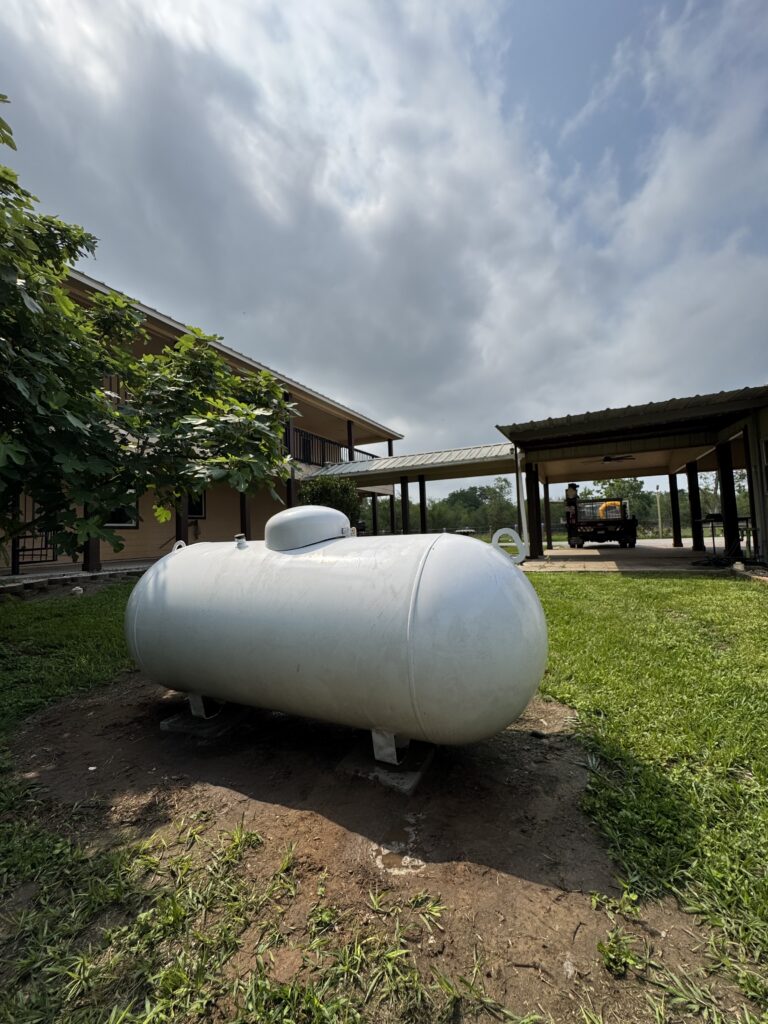
For common residential aboveground tanks, 250-, 320-, and 500-gallon tanks generally require at least 10 feet of separation from important buildings and adjoining property lines that can be built upon. A 1,000-gallon tank generally falls into the 501- to 2,000-gallon category, where the standard separation is 25 feet.
A specific exception can allow the 25-foot distance to be reduced to no less than 10 feet for a single container of 1,200 gallons water capacity or less when that container is at least 25 feet from any other LP-Gas container larger than 125 gallons water capacity. RRC builder checklist
Those figures are planning guidelines, not a substitute for inspecting the property. Building openings, ignition sources, utilities, tank fittings, delivery access, other containers, and the site layout can affect the final compliant location.
Should You Fill Your Propane Tank Before a Hurricane?
Yes. If your home relies on propane for backup power, it is wise to make sure you have an adequate fuel supply before a hurricane threatens Greater Houston.
Once a major storm approaches, propane demand can increase, delivery schedules can fill up, and road conditions after the storm may make deliveries more difficult. Do not wait until the tank is nearly empty and a hurricane is already approaching the Gulf Coast.
Homeowners in flood-prone areas should also remember that fuel level is not a substitute for proper tank anchoring where anchoring is required. After severe flooding or storm damage, propane equipment should be evaluated by a qualified professional before service is restored. Noremac hurricane safety guidance
How Does Noremac Propane Size a Tank for a Standby Generator?
Noremac Propane does not determine tank size from generator kW alone. During a free site survey, the property and propane needs are evaluated to help determine an appropriate tank size and installation location.
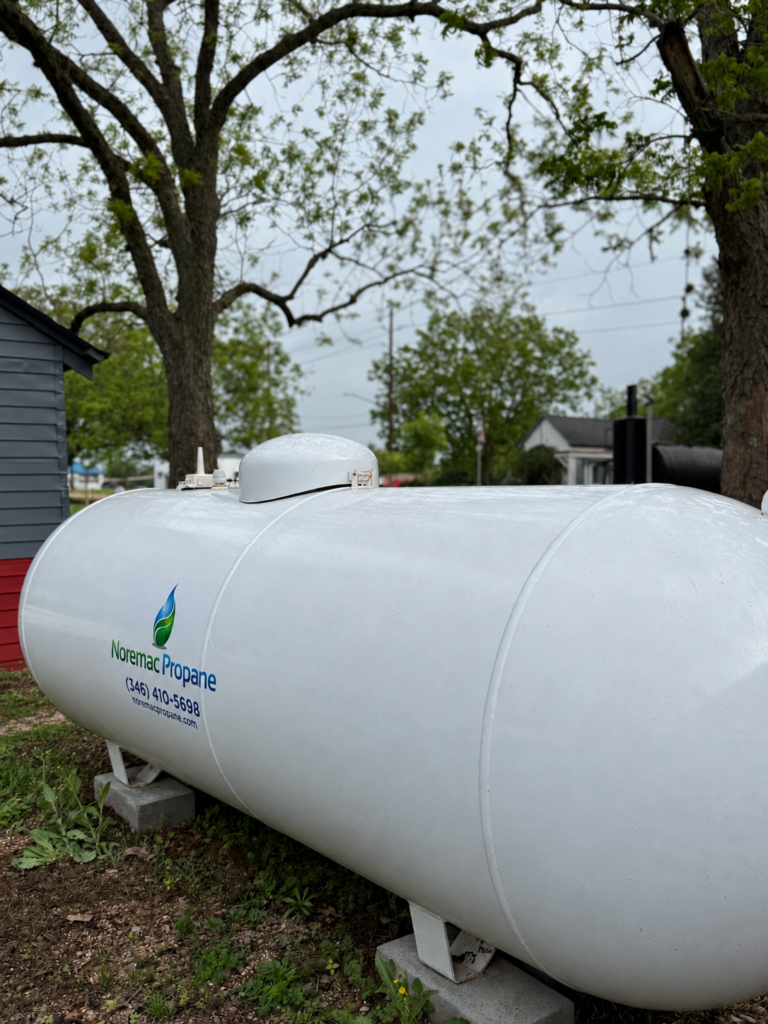
Noremac considers factors such as:
- Propane usage and appliances
- Standby generator needs
- Proposed tank location and required clearances
- Property layout
- Delivery access
Noremac installs 120-, 250-, 320-, 500-, and 1,000-gallon aboveground tanks throughout Greater Houston. Learn about Noremac tank installations
For a generator installation, those property considerations can be evaluated alongside the generator manufacturer’s fuel-consumption specifications and the homeowner’s desired backup duration.
Two homes with the same 22kW generator may have completely different propane needs. One may use propane only for the generator and want a short emergency reserve. Another may use propane for the generator, water heating, cooking, fireplaces, and a pool heater while planning for a longer outage. That is why a site survey is more useful than a generic sizing chart.
Frequently Asked Questions About Propane Tanks for Whole-House Generators
What size propane tank is best for a whole-house generator?
There is no single best size for every home. A 500-gallon tank is a practical starting point for many installations, while a 250- or 1,000-gallon tank may make more sense depending on fuel consumption, desired runtime, other propane appliances, available space, and delivery preferences.
What is the minimum propane tank size for a Generac generator?
Generac currently specifies a minimum 250-gallon LP tank for its home standby generators. That minimum does not mean 250 gallons will provide enough backup time for every homeowner.
How long will a 500-gallon propane tank run a 22kW generator?
Using about 300 gallons between an 80% tank level and 20%, a current Generac 22kW generator provides an estimated 5.1 days at a constant 50% load or about 3.4 days at full load. Actual runtime varies with electrical demand and other propane usage.
Can my generator use the same propane tank as my house?
Yes. A properly sized system can supply both the standby generator and household propane appliances. However, every appliance draws from the same fuel reserve, so total runtime will be lower when the tank is serving multiple loads.
Why does a 500-gallon propane tank only hold about 400 gallons?
Propane tanks are normally filled to approximately 80% of rated capacity to leave room for liquid propane to expand as temperature changes. An 80% fill on a 500-gallon tank is approximately 400 gallons.
How far does a 500-gallon propane tank need to be from a house in Texas?
A 500-gallon aboveground tank generally requires 10 feet of separation from important buildings and adjoining property lines that can be built upon, although other clearances and site conditions can affect the final installation location.
Find the Right Propane Tank for Your Whole-House Generator
Choosing the right propane tank size for a whole-house generator comes down to more than generator wattage. The best tank for your property depends on generator fuel use, desired backup duration, other propane appliances, delivery preferences, and where the tank can safely be installed.
Noremac Propane serves homeowners throughout Greater Houston with aboveground propane tank installations, residential propane delivery, tank monitoring, and generator fuel support.
Need help choosing the right propane tank size for your standby generator? Contact Noremac Propane or call (346) 410-5698 to schedule a free site survey.