

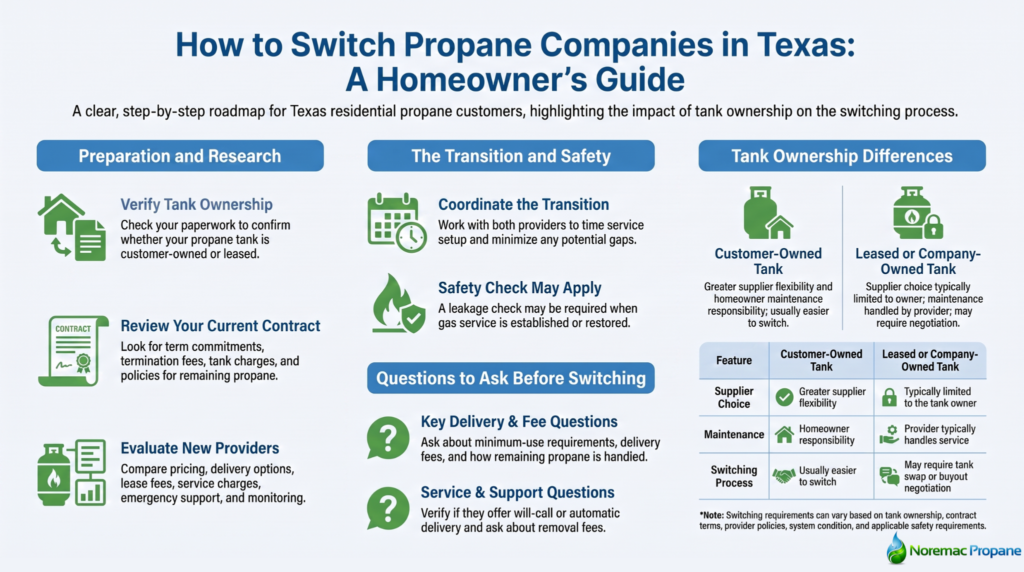
Thinking about changing propane providers? The good news is that Texas homeowners can generally switch propane companies, but the process depends on a few important factors, especially who owns the propane tank, what your current service agreement says, and whether equipment needs to be removed or replaced.
If you own your propane tank, switching is usually more straightforward because the tank may remain in place. If your current propane company owns or leases the tank to you, changing providers may involve a tank swap, removal, buyout, or another arrangement.
In Texas, LP-gas safety is regulated by the Railroad Commission of Texas, which oversees propane company licensing and individual certification for regulated LP-gas activities. Pricing, cancellation terms, tank lease fees, and many other aspects of your service relationship can vary by provider and agreement.
Quick Answer: Before switching propane companies, find out who owns your tank, review your current agreement for potential fees or notice requirements, compare the total cost and service options of new providers, and coordinate the transition carefully to minimize any interruption in propane service.
Can You Switch Propane Companies in Texas?
Generally, yes. However, changing propane providers is not always as simple as calling a different company for your next delivery.
The first question to answer is:
Who owns the propane tank?
That single detail can have a major impact on how the switching process works.
A customer-owned tank may be able to stay in place when you change providers. A leased or company-owned tank, on the other hand, may need to be removed, replaced, purchased, or otherwise addressed before another supplier begins regular service.
Your current service agreement may also include notice requirements, minimum-use commitments, cancellation fees, equipment removal charges, or other terms that could affect the transition.
First, Determine Who Owns Your Propane Tank
Customer-Owned Propane Tanks
If you own the propane tank, it can generally remain in place when you change providers, provided the new propane company is willing to service the equipment and applicable safety requirements are met.
Owning the tank may give you greater flexibility to compare:
- Propane pricing
- Delivery options
- Service fees
- Automatic versus will-call delivery
- Tank monitoring
- Emergency and after-hours support
A new propane provider may still need to evaluate the existing tank and gas system before beginning service.
Leased or Company-Owned Aboveground Tanks
If your current propane provider owns the tank, changing companies may require the old tank to be removed and another tank installed.
Depending on the companies and equipment involved, other possibilities may include a tank buyout or ownership transfer. These arrangements are not guaranteed and may depend on the tank owner, the condition and age of the equipment, your service agreement, and the policies of the companies involved.
Leased Underground Propane Tanks
A leased underground propane tank can make switching more complicated because physically removing and replacing a buried tank may require excavation and backfilling.
In some cases, a homeowner may ask whether the current provider is willing to sell the existing tank or whether another ownership arrangement is available.
However, if you already own the underground tank, changing propane companies does not automatically mean it must be excavated or removed. A new supplier may be able to service the existing equipment if the company accepts the tank and applicable safety requirements are satisfied.
Can Another Propane Company Fill a Leased Tank in Texas?
Generally, propane companies will not fill a tank owned by another supplier without the owner’s authorization.
Federal OSHA regulations include an owner-authorization rule for LP-gas containers. Although OSHA is a workplace safety authority rather than a Texas residential consumer-protection agency, its standard reflects the broader principle that an LP-gas container should not be filled without the owner’s authorization.
Texas law also provides a limited emergency exception under Texas Business & Commerce Code § 2002.004, which may allow a nonowner to fill or refill another owner’s LP-gas container under specific emergency circumstances.
For a routine provider change, however, homeowners with a leased or company-owned tank should expect to address the existing equipment before another supplier begins regular service.
What Happens to the Propane Left in Your Old Tank?
This is one of the most important questions to ask before switching propane companies.
If propane remains in a tank that is being removed, how that fuel is handled can vary by provider and service agreement.
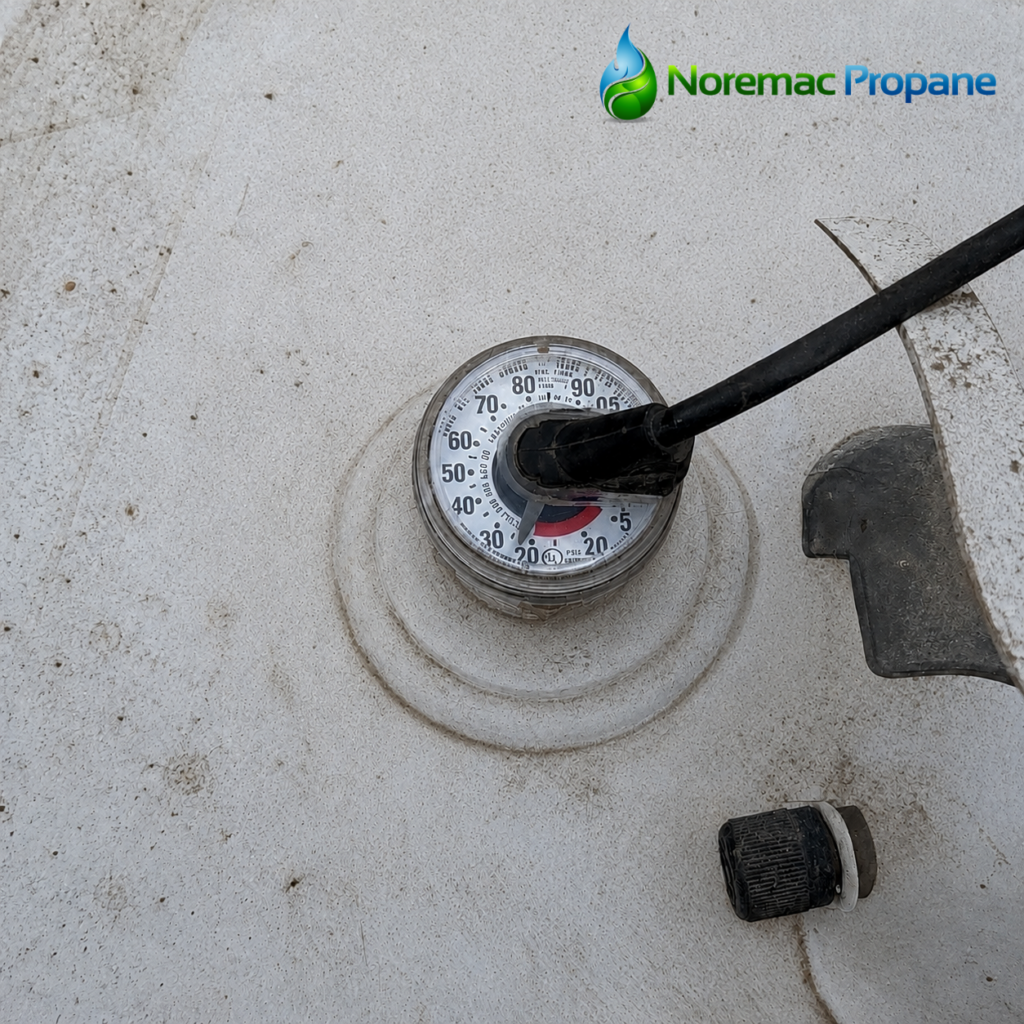
Depending on the company, the process may involve:
- A credit for remaining propane
- A refund under the provider’s policy
- A pump-out fee
- A restocking fee
- Tank removal or pickup charges
Do not assume that unused propane will automatically be refunded at the same price you originally paid.
Before canceling your account, ask your current provider:
How will the propane remaining in my tank be handled if I cancel service, and will any fees be deducted from a potential refund or credit?
It is a good idea to get that answer in writing.
Federal transportation requirements also vary based on tank size, propane level, carrier, and the circumstances of transportation. There is no single universal rule that every propane tank must always be drawn down to exactly 5% before it can be moved.
Your propane provider should explain how the remaining propane and equipment will be handled in your specific situation.
Are Safety Checks Required When Switching Propane Companies?
Changing propane providers does not automatically mean every homeowner needs the same inspection or pressure test.
However, safety requirements may apply when gas is introduced into a new system or initially restored following an interruption of service.
Railroad Commission of Texas materials reflecting NFPA 54 state that the piping system must be checked for leakage when gas is turned on into a new system or initially restored after an interruption of service.
Additional inspections or testing may depend on:
- Whether propane service was interrupted
- Whether a tank was disconnected or replaced
- Whether gas piping was altered or repaired
- The condition of the existing system
- Applicable safety requirements
- The new provider’s own safety procedures
A leakage check and a pressure test are not necessarily the same procedure, and simply changing propane companies does not automatically mean every system requires a pressure test.
A provider may also charge separately for certain safety inspections or leakage checks. Ask the new company in advance whether any such fees apply.
How to Switch Propane Companies in Texas: 6 Steps
1. Determine Who Owns Your Propane Tank
Review your purchase documents, lease agreement, bill of sale, service records, or other paperwork to confirm whether the tank is customer-owned or belongs to a propane company.
Also determine whether the tank is aboveground or underground.
2. Review Your Current Service Agreement
Before canceling, check for:
- Contract terms
- Early termination fees
- Required notice periods
- Tank removal or pickup charges
- Minimum-use requirements
- Pump-out or restocking fees
- Policies for propane remaining in the tank
Knowing these terms before you make the switch can help prevent unexpected costs or delays.
3. Compare New Propane Providers
Do not compare propane companies based only on the advertised price per gallon.
Ask about the complete cost and level of service, including:
- Propane pricing
- Delivery fees or surcharges
- Minimum delivery amounts
- Tank lease charges
- Annual minimum-use requirements
- Automatic and will-call delivery
- Tank monitoring
- Emergency and after-hours support
- Safety or account setup fees
The lowest advertised propane price does not always mean the lowest total cost of service.
4. Ask How the New Provider Would Handle Your Tank Setup
Tell the company whether your tank is:
- Customer-owned or leased
- Aboveground or underground
- Currently in service
- Partially full
Then ask whether the existing tank may remain in place or whether removal, replacement, a buyout, ownership transfer, or another arrangement may be needed.
5. Coordinate the Transition
Work with your current and new providers to reduce the risk of a service interruption.
The proper timing and sequence can depend on:
- Tank ownership
- Tank location and accessibility
- Remaining propane
- Provider schedules
- Weather
- Equipment availability
- The condition of the existing system
A same-day tank swap is not always necessary or possible. The best approach depends on the property, the equipment, and the companies involved.
6. Complete the Switch and Close the Old Account
Depending on the situation, the new provider may need to perform applicable safety procedures before placing the system into operation.
Once the transition is arranged, notify the old company according to your service agreement. If the previous provider owns equipment on the property, ask:
- When will the tank be retrieved?
- Will removal fees apply?
- What access is required?
- How will the remaining propane be handled?
Keep copies of important communications and final account records.
Thinking About Switching Propane Companies in Texas? Watch This Quick Overview
What Fees Should You Ask About Before Switching?
Every propane company structures its pricing differently, so it is important to look beyond the advertised price per gallon. Before switching providers, ask whether any one-time or recurring charges could apply to your account.
Possible costs may include:
- Early termination fees if you end a fixed-term agreement before it expires.
- Tank removal or pickup fees if your former supplier needs to disconnect and retrieve company-owned equipment.
- Pump-out or restocking fees if unused propane must be removed or otherwise handled before the tank is transported.
- Safety inspection or leakage-check fees when service is established or restored and additional safety procedures are required.
- Underground tank costs if a buried tank actually needs to be removed, replaced, excavated, or backfilled.
The goal is to compare the total cost of service, not just the propane price per gallon. Ask each provider for a clear breakdown of possible delivery charges, tank lease fees, monitoring fees, minimum-use requirements, surcharges, and other recurring costs before making a decision.
6 Questions to Ask a New Propane Company
Before choosing another provider, ask:
- Is your company properly licensed with the Railroad Commission of Texas, and are your technicians appropriately certified for the work they perform?
- What tank lease, delivery, monitoring, setup, or service fees do you charge?
- Do you have minimum annual fuel-purchase requirements?
- Do you offer automatic delivery, will-call delivery, or both?
- If establishing or restoring my service requires a leakage check, do you charge separately for that service?
- If I leave your company in the future, how will tank removal, remaining propane, refunds or credits, and cancellation fees be handled?
These questions can help you compare providers based on the complete service experience rather than price alone.
Thinking About Switching Propane Companies in Greater Houston?
At Noremac Propane, one of the first things we look at when helping a homeowner consider switching providers is tank ownership. That helps determine whether the existing tank may remain in place or whether another arrangement may be needed.
We also consider practical factors such as:
- How much propane remains in the tank
- Whether the tank is aboveground or underground
- Tank accessibility
- Weather conditions
- Scheduling
- The condition of the existing equipment
Every property is different.
Whether you own your propane tank, lease from another provider, or are not sure who owns the equipment, Noremac Propane can help you understand your setup and discuss the next steps.
Call Noremac Propane at (346) 410-5698 or contact us online to get started.
Serving homeowners throughout Greater Houston.
Frequently Asked Questions
Can I switch propane companies in Texas?
Yes. Texas homeowners can generally choose another propane provider, although the process may depend on tank ownership, contract terms, remaining propane, equipment removal, and applicable safety requirements.
Do I have to replace my propane tank when changing companies?
Not always. If you own your tank, it may generally remain in place if the new provider accepts the equipment and applicable requirements are met. A leased or company-owned tank may require removal, replacement, a buyout, ownership transfer, or another arrangement.
Can another propane company fill a leased propane tank?
Generally, a propane company will not fill another supplier’s tank without the owner’s authorization. Texas law provides a limited emergency exception under specific circumstances.
What happens to propane left in the tank when I switch?
That depends on the provider and service agreement. Ask whether remaining propane may qualify for a refund or credit and whether pump-out, restocking, removal, or other fees may apply.
Is a leak check required when switching propane companies?
Not automatically in every situation. A leakage check may be required when gas is introduced into a new system or initially restored after an interruption of service, and providers may have additional safety policies.
Is switching harder with an underground propane tank?
It can be more complicated if a leased underground tank must actually be removed or replaced. A customer-owned underground tank may be able to remain in place if the new provider accepts the equipment and applicable safety requirements are met.
Sources and References
This guide was developed using information from authoritative regulatory, legal, and safety sources, including:
- Railroad Commission of Texas, Alternative Fuels Safety
- Texas Business & Commerce Code § 2002.004
- 49 CFR § 173.315(j)
- OSHA 29 CFR § 1910.110
- NFPA 54 guidance as reflected in Railroad Commission of Texas materials
This article is provided for general informational purposes and is not legal advice. Requirements, fees, company policies, and procedures may vary depending on the property, equipment, provider, service agreement, and applicable regulations.